
Window shape guide
Getting bay window blinds right, pane by pane
A bay window is not one window, it is several meeting at angles, and the single biggest mistake people make when buying blinds for one is treating it as a single wide opening. Order that way and you end up with a headrail that either will not turn the corner or leaves an ugly gap at every join.
This guide walks through the two common bay shapes, why each aperture needs its own blind, and which blind type actually copes best with the brackets and corners a bay creates.
Angled bays versus square bays
An angled bay has a central window flanked by two side windows set at 30 to 45 degrees, common in Victorian and Edwardian fronted houses across Hythe and the surrounding towns. A square bay, more common in newer builds, has three windows meeting at 90 degree corners. The angle changes how much clearance the corner brackets need, but the core rule is the same for both: measure and fit each window separately.
A third, less common shape is the bow window, where four or five narrower panes curve gently rather than meeting at sharp angles. Bows need even more attention to bracket projection than a standard bay, since the angle between neighbouring panes changes gradually rather than being fixed, which rules out a generic corner kit entirely.
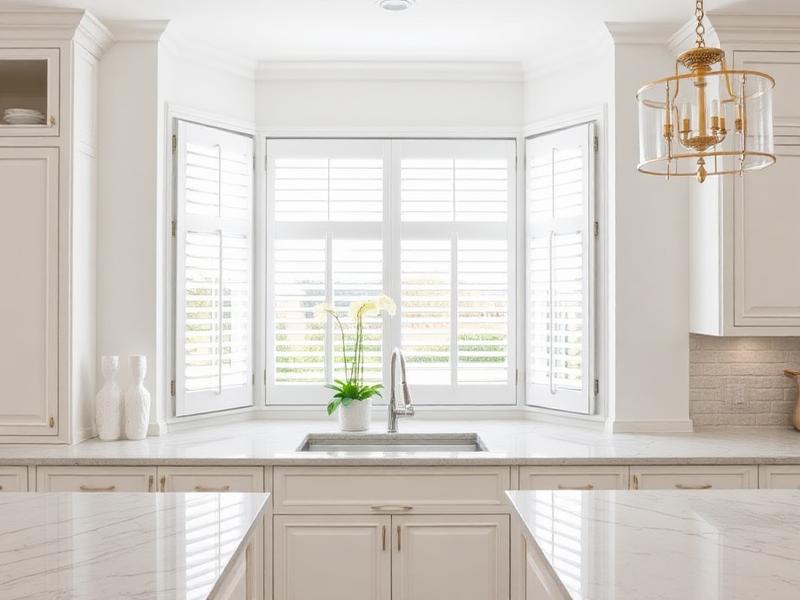
Why individual blinds beat one continuous run
A single continuous headrail cannot physically bend around a bay corner, so any attempt to bridge the angle either needs a specialist corner bracket kit or ends in a compromise that leaves a gap. Fitting one blind per aperture, each cut to its own width and drop, gives a clean, independent finish at every window and means one blind can be raised for a view out while the others stay down for privacy.
- Each pane gets its own bracket set, sized to that window's depth.
- Corner brackets are chosen to suit the actual angle, not a generic 45 degree assumption.
- Individual control means one blind can be up while the others are down.
Brackets and the corner gap problem
The gap that appears at a bay corner is usually caused by brackets that project too far forward, forcing the blinds to sit further apart than the frame does. Slim projection brackets, chosen specifically for the corner angle, close that gap down to a few millimetres rather than leaving a visible strip of glass showing between blinds.
Roller blinds in a bay
Rollers work well in a bay when each pane is a manageable width, giving a clean, low profile finish that turns the corner neatly bracket to bracket. On a very wide central pane a roller can start to sag slightly at the centre over time, so a slightly heavier fabric or a supported tube is worth asking about.
A recess-fit roller in a bay also needs each reveal checked individually, since side panes in an angled bay are frequently a few millimetres shallower than the central window, which changes the bracket projection needed to clear any handle on that pane.
Venetian blinds in a bay
Venetians give you slat-level control at each pane independently, which suits a bay that gets strong low sun through the side windows at different times of day than the centre. The trade off is that a wood or faux wood headrail is bulkier, so corner clearance needs closer attention than with a roller.
Vertical blinds in a bay
Verticals suit a wide, shallow bay, particularly in a dining room or conservatory-adjacent space, because the individual louvres can be angled to control glare without fully closing the view. They need more floor to ceiling drop clearance than a roller or Venetian, so check nothing below the sill will catch the swinging louvres.
Getting the corner angle right at the survey
Because the exact angle between panes varies from house to house, and even from window to window in the same bay, this is a job that benefits from being measured on site rather than estimated from a room photo. Our free home consultation includes checking each aperture and the corner angle so the bracket kit specified is the right one first time.
Cordless and motorised control across three or five blinds
A bay window is one of the few places where operating several blinds by hand genuinely becomes a chore, especially if the side panes are set at an awkward angle to reach across furniture. Cordless spring rollers remove the trailing chains that can tangle between adjacent panes, and a motorised set, grouped to a single remote or app scene, lets you raise the whole bay together or adjust one pane on its own.
This matters more in a bay than on a flat wall of windows because the side panes often sit above a window seat or radiator, where a hanging cord or chain is both awkward to reach and closer to small hands than people first assume.
The short version
How to dress angled and square bay windows properly, one aperture at a time, including the bracket and corner gap issues that decide whether roller, Venetian or vertical blinds are the right choice for your bay.
Window shape guide - your questions
Keep reading
Discover more of our made-to-measure window dressing services across East Kent.